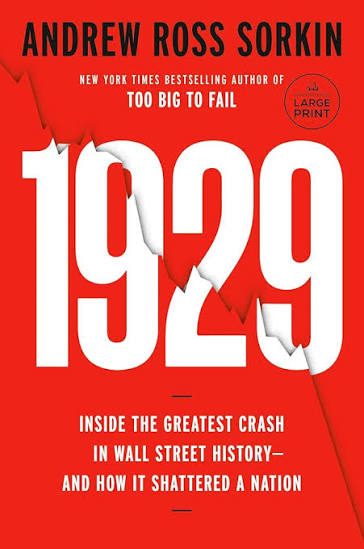
1929: Inside the Crash
- Read
- 9 Nov 2026
- Shelf
- Economics & ideas
A Narrative History about the Great Stock Market Crash of 1929
Background
The 1920’s in the United States are often called the roaring twenties when stock markets attained unprecedented heights. The Dow Jones Industrial Average (DJIA) has increased six times from 63 in August 1921 to 381 in September 1929. The euphoria was unabated and most experts / top bankers felt that the optimism reflected the unchallenged economic position of the United States. The stock market crash that followed in 1929 caught most people by surprise and ultimately led to the Great Depression. This book is a well-researched account of the events leading up to and following in the aftermath of the stock market massacre. The DJIA reached its lowest point in the summer of 1932 when it was 90% off from its peak. It would take another two decades for the index to reach its previous high.
Bull Run in the 1920’s
The 20’s was characterized by optimism backed by real changes in the US. These were:
- Technological boom: Electricity had reached most American homes and production of white goods / cars / radios / telephone was peaking. The tech stocks of that era included GM, Radio Company.
- America – The World’s Banker: Post World War I, Europe owed the US money, and New York took over London as the financial capital of the world.
- Laissez-faire approach: Under**** Presidents Harding and Coolidge, taxes were cut and the philosophy was to minimize government intervention in the economy.
- Proliferation of Credit: The**** era of easy credit had begun as buying goods on installments started to become popular. This also extended to buying stocks. Ordinary people were able to buy stocks by putting up as little as 10-20% margin.
Great Stock Market Crash of 1929
The book really picks up from here. Like most crashes, there was no single cause. Fragile conditions met a few triggers.
Fragile Conditions
- Prices were far ahead of profits. Like most bubbles, valuations stopped making sense.
- Huge leverage. Loans to stock buyers ballooned to roughly $8.5 billion by October 1929, more than all the currency circulating in the US. When prices fell, brokers demanded more cash (“margin calls”). Investors who couldn’t pay were sold out automatically, which pushed prices down further.
The triggers
- Rate tightening. FED pressured banks to stop lending for speculation in early 1929, and in August it raised its rate to 6%.
- The economy was already slowing. Industrial production and home building had peaked in the summer of 1929, before the crash.
- Shocks from abroad and at home. The fraud-driven collapse of Clarence Hatry’s empire in London in September 1929 rattled investors. So did a ruling by Massachusetts regulators against a utility stock and talk of a big new tariff.
The crash itself
- Black Thursday (24 October 1929): panic selling. A group of top bankers, led by Thomas Lamont of J.P. Morgan, pooled money to buy shares. Richard Whitney of the Stock Exchange walked onto the floor and bid well above the market for US Steel. It worked for a day.
- Black Monday and Black Tuesday (28–29 October): the market fell about 13% and 12% on consecutive days, and the bankers’ support gave way.
- The long slide. After a rally in early 1930, the market kept falling until July 1932, when the Dow hit about 41, down almost 90% from its peak. It didn’t get back to its 1929 level until 1954.
The Great Depression and how it’s linked to the crash
The Great Depression was the worldwide economic collapse of roughly 1929 to 1939, the worst in modern history. In the US, the worst stretch was 1929 to 1933. The common belief is that the crash caused the Depression. Most economists now say that’s only partly true:
- What the crash did: it destroyed a lot of household wealth and shattered confidence. People and businesses stopped buying cars, appliances and machinery, and that alone would probably have caused a bad recession.
- What turned it into a depression: the policy mistakes and banking failures of 1930–33, covered below. The banking system collapsed, the money supply shrank by about a third, and prices fell steeply. Falling prices made debts harder to repay, which caused more defaults and more bank failures.
In 2002, Ben Bernanke, later Fed Chairman, told Milton Friedman, the economist who made this argument famous: “Regarding the Great Depression… you’re right, we did it. We’re very sorry.”
What happened during the Great Depression
- The economy shrank by about a quarter. US output fell roughly 25–27% between 1929 and 1933, and industrial production fell by almost half.
- One in four workers was jobless. Unemployment reached about 25% in 1933, up from about 3% in 1929, and there was no unemployment insurance.
- Prices fell about 25%. That sounds good, but it bankrupted farmers and borrowers, whose incomes fell while their debts stayed the same.
- World trade fell by about two-thirds in value, spreading the Depression worldwide.
- Daily life: bread lines and soup kitchens, shanty towns called “Hoovervilles,” families losing farms and homes, and the Dust Bowl droughts forcing hundreds of thousands to migrate west. That migration is the backdrop of The Grapes of Wrath.
- Political upheaval: extremist movements grew across Europe, democracy collapsed in Germany, and the Depression is widely seen as one of the roots of the Second World War.
- The end: recovery was slow and uneven. Full employment returned only when the US rearmed for the Second World War, around 1940–41.
Learnings from the aftermath of The Great Depression
Much of today’s financial system was built as a reaction to 1929–33:
- Deposit insurance, which in India is DICGC.
- Securities regulators: the SEC in the US, which is the model for SEBI.
- Limits on margin and leverage.
- Central banks acting as lenders of last resort. That lesson is why the Fed and other central banks flooded markets with money in 2008 and 2020, instead of letting banks fail.